Reasons to Support Local Organic Veg Box Schemes
If you don’t grow your own no-dig veggies, local veg box schemes are one alternative to supermarkets, to order fresh fruits and veggies. Many are organic, others avoid pesticides but are not certified organic, simply because it’s an expensive and lengthy process to get certified, so don’t discount smaller organic box schemes with no logos.
Read more on no-dig gardening and humane slug/snail deterrents. If you live with animal friends, read up on pet-friendly gardens (some recommended flowers and fruit trees are not safe). Also avoid netting to protect food (just leave some for wildlife!)
Farmers need a government license to sell to the public (also buy liability insurance). Know food hygiene rules.
Box schemes basically have you sign up weekly or fortnightly, to receive a varied box of fresh seasonal produce, which has very low food miles, and helps to support small independent farmers. It’s a no-waste and affordable way to enjoying good tasty food, in season.
Veg Box Safety Tips
Check paper medication inserts, as some people should avoid grapefruit, rhubarb and green leafy veggies. Keep boxes in a safe place (like a shed) away from pets due to alliums (onion, garlic, leek, shallots, chives) and citrus fruits. Read more on food safety for people and pets. If buying flowers alongside, read up on pet-friendly gardens (many are unsafe near animal friends).
Due to acids, it’s best to avoid composting citrus fruits as they could harm garden creatures (just bin to break down naturally). Same with tomatoes, rhubarb and alliums.
If tinned foods are ordered alongside (some veg boxes offer grocery items). fully remove lids before recycling (or pop ring-pulls back over holes, to prevent curious wildlife getting trapped inside).
How Do Veg Box Schemes Work?
You simply sign up for a weekly or fortnightly box (some also offer groceries to go alongside). You usually can either choose individual produce, or more often just sign up a for a set box, so you usually get a surprise, depending on what’s in season.
Most boxes let you cancel easily or postpone (say if you go on holiday or had to go into hospital). And some also let you filter out things you don’t like or can’t eat, to get a substitution, to avoid waste.
The boxes are usually sold in various options: says boxes for one or two people, ones for small or large families. Plus there are often boxes for veg only, fruit only, or usually a mixture. Some even offer specialty boxes like ‘no potatoes’ or smoothie boxes.
There’s no plastic. You then just leave your empty cart/box out the next week, and get it replaced by a new box.
The Benefits of Local Veg Boxes
Where do we start?! For a start, you are supporting small independent farmers who grow organic produce. Then you are also benefiting from eating more plastic-free fresh produce.
Another big advantage is low food miles. Around 25% of road traffic in England is from lorries thundering produce along motorways to deliver food to central distribution houses, which then chill the produce, until it’s travelled again by lorry back to big supermarkets.
All of this uses oil (lorries, fridges, lighting and pesticides which are made with oil). If we want an oil-free economy (which is good to prevent oil spills to climate change), this is one good step. Plus veg boxes are more affordable, as they cut out the middlemen, and packaging.
Having a veg box also encourages you to eat more fruit and veg, and be creative in making simple recipes. If you buy a bag of rock-hard pears at the supermarket, some may go to waste. But if you get a bunch of juicy ripe local pears delivered to your door, you’ll likely be inspired to eat them, or turn them into a nice recipe, to avoid wasting such delicacies!
What To Do during England’s Hungry Gap?
England can grow all its own food. But around April, there is something called a ‘hungry gap’. This is when all the winter produce has been harvested, and the spring/summer harvest is not yet ripe. Kale is one of the few foods that is possible to grow year-round.
Some box schemes get around this by growing certain crops in polytunnels. And obviously we can’t grow some popular fruits like oranges, lemons and bananas. So most box schemes either avoid selling them, or do import them but sea-freight, to avoid air pollution.
Where to Find Local Box Schemes

Just look them up online. As said above, some are naturally organic, so won’t be listed with official organisations.
The Food Assembly links customers with local farmers, just pick up your delivery from a nearby pick-up point like a community hall or school. Produce changes weekly, depending on what’s in season.
Kentish Town Veg Box (London) offers affordable veg bags (and optional fruits like rhubarb) with farmers receiving around 60% of each pound spent. Pick-up points are more affordable, or have home delivery with a surcharge. You can even buy basil from London and aubergines from Kent! And donate to give discounts, for people on low incomes.
Riverford (London) delivers boxes of different sizes, with extras like salad or bread. Everything is picked to order, and delivered within 48 hours of harvest.
Growing Communities (East and South London) has boxes starting from £10, using pick-up points to keep prices low. Farmers receive 50% of the price you pay (three times more than supermarkets) for a resilient food system that is not affected by rising oil prices. It also sells wholesale.
Sutton Community Farm (South London) delivers seasonal, organic fruit and veg boxes as well as pantry staples to homes or pick-up points, grown on their community-owned farm and sourced from trusted organic partners.
Unlike nationwide schemes, every order directly supports a hyper-local farm that’s rooted in community— making eating more veg feel joyful, personal, and impactful.
Abel & Cole (London) sells organic veg boxes, you can add a pick-up bag to your order to seal rinsed soft plastic packaging (from any retailer) that is collected with empty boxes for recycling. Seasonal produce includes:
- Spring (new potatoes, asparagus, spring greens, rhubarb)
- Summer (strawberries, tomatoes, cucumbers, courgettes)
- Autumn (apples, pears, squash, kale)
- Winter (parsnips, carrots, leeks, cabbage)
You can also add organic oat drink in returnable glass bottles, sourdough bread and plant-based yoghurt.
Veg Boxes That Use Up Food Waste
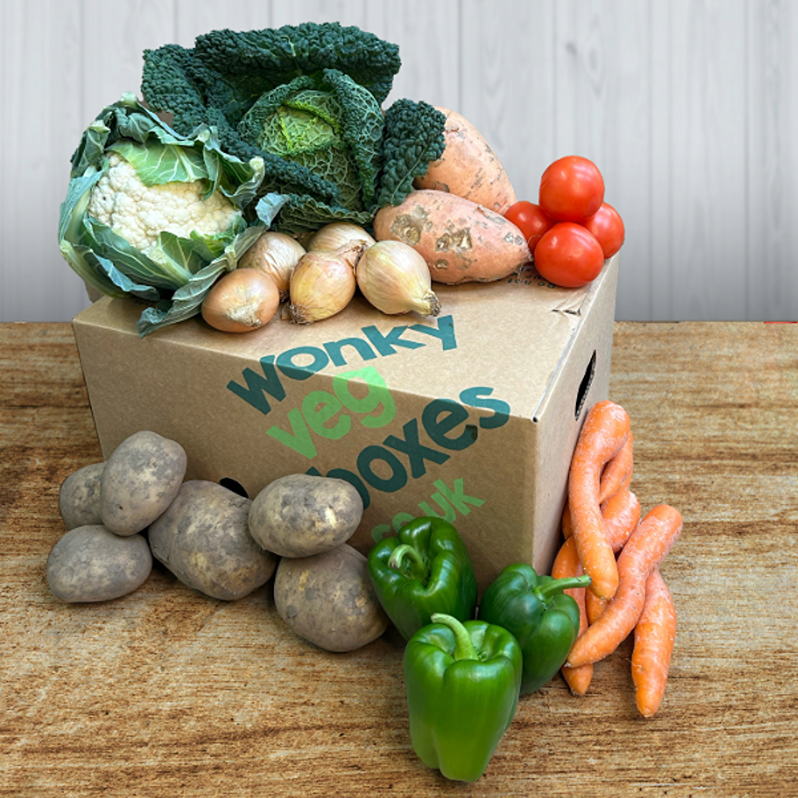
These are not always organic, but use up food that would otherwise go to waste. This food is often rejected by supermarkets because it’s wonky or odd-shaped and works out more affordable.
Food campaigner and chef Hugh Fearnley-Whittingstall is not impressed by ‘supermarket wonky produce’. He says it’s often the supermarkets themselves that are rejecting ‘imperfect produce’. Then tries to sell wonky leftovers, for more profits.
Despite being a food waste champ, Hugh has a guilty secret. Unlike his wife who can eat the whole apple including the core, he can’t. He says she can bite off the ends and middle to leave a tiny stalk, but he is still left with a ‘pencil-sized core!’
- Earth and Wheat sells wonky fresh produce and bread, and a vegan grocery store. Produce sold here has been rejected by others for being too big, long, blemished, too thin or the wrong colour.
- Wonky Veg Boxes again helps to buy up and sell ‘imperfect produce’ that farmers have had rejected by supermarkets: often carrots, parsnips, potatoes and apples with odd shapes or little scars.
- Oddbox offers dinky apples to curvy courgettes, with clear pricing for surprise boxes in plastic-free packaging. Nationwide delivery is available.